

🎧 Magnetic by Andfølk at low volume on loop.
Since I was three years old, every Grand Slam has been on the television in my house. My father put it there the way some fathers insist on church — not as background noise but as something that mattered, though I didn’t know why yet. I just knew I liked the way the ball sounded.
It didn’t take long to find the figure who would define, for me, what greatness looked like before I had the vocabulary to say so. Roger Federer.
I watched twenty years of his career in real time. The 2008 Australian Open semifinal loss against Novak Djokovic that lodged in my chest like a splinter. The Wimbledon final against Rafael Nadal that same year that left a wound of its own. The nearly five-year drought between 2012 and January 2017. And the night it ended in Melbourne against Rafa in what I believe was a once-in-a-lifetime event disguised as a tennis match. The 2019 Wimbledon final against Novak that took me years to make peace with.
I watched his contemporaries — Nadal and Djokovic — chase their own versions of the same summit by entirely different routes. And somewhere in the watching, a question formed that I’ve only recently learned how to ask.
What is the cost of greatness?
Not the definition of greatness. We exhaust ourselves debating that. Is it the titles, the mentality, the character, the God-given talent, the work ethic? It is obviously all of these, which is what makes the question useless. Nobody has ever become great in only one dimension.
The real question is not what greatness requires but what it costs — because everything worth having has a price, and the price is not always printed on the tag.
I believe the connecting factor, the thing that makes all the dimensions of greatness cohere rather than compete, is frequency. Not in the mystical sense, though it functions that way. Frequency as a state of awareness. A sustained pitch of consciousness that allows a person to work with passion rather than against pain; to love winning more than hate losing. These are Roger’s own words. Repeated in press conferences after his most brutal defeats, delivered with a lightness that made the depth of what he was saying easy to miss.
Frequency is what makes the obligations of greatness — the press, the sponsors, the fans, the airports, the recovery, the repetition — feel like extensions of the game rather than taxes on it. And frequency is what separates the fulfilled from the merely accomplished.
Watch Roger in almost any interaction and you’ll see it. A goofiness that arrives easily. A seriousness that commands attention without demanding it. A man who appears to be enjoying the life his greatness built, not recovering from it. Watch Carlos Alcaraz — still young, still unfinished — and you see the same signal in its own form. The laughter, the lightness, the sense that the game is still, fundamentally, play. Their cost of greatness appears, from the outside, to be almost nothing.
But that’s the illusion. The cost is always there. It’s just that some frequencies make the cost feel like an investment, and others make it feel like a debt.
Let me explain what I mean by cost.
You walk into a store and buy a pair of tennis shoes for a hundred and eighty dollars. What you get is maybe fifteen percent better footwork, twenty percent better feel, thirty percent less durability than the last pair. The shoes have a cost and a return, and you weigh them against each other — consciously or not — before you buy. At a hundred and eighty, maybe the math works. At four hundred, maybe it doesn’t. The cost didn’t change the shoes. It changed whether the shoes were worth it.
Greatness works the same way. Every path to it carries a specific cost determined by the frequency you choose to walk it at. And the frequency you choose determines not just how great you become but how you feel about it when you arrive.
Tom Brady. The greatest quarterback who has ever lived. The aesthetic persona, the humility, the social intelligence, the authenticity, and above all the work ethic. A drive so consuming it became its own weather system, bending everything in his orbit toward the game. His cost was his marriage. Only he can say whether the trade was worth it, and I genuinely hope it was, because what he built is other-worldly. Even at his frequency — one of the highest a human being can sustain — the cost was real, and it was personal, and it was permanent.
There being a cost does not mean you should not pay it. It means you should know it. Know what you’re buying and what it costs before you hand over the years.
This is where the stories of the three greatest tennis players begin to diverge. Not in talent or titles but in the frequency each chose and the cost each bore.
Nadal’s frequency was willpower. Pure, physical, almost punitive willpower. The ability to override pain, to outlast, to transform suffering into fuel. This is partly constitution and partly construction; his uncle Toni built the competitive architecture of Rafa’s mind from boyhood, and it was built to withstand anything. And it did. Twenty-two Grand Slams. A left-handed forehand, when he was born right-handed, that eventually rewrote the physics of clay. A career that was, in the most literal sense, fought for.
But willpower is the most expensive frequency there is, because it asks the body to fund what the mind demands. And I think — watching from the outside, which is all any of us can do — that Rafa’s cost arrived with retirement. I noticed it at the 2026 Australian Open final, watching Alcaraz and Djokovic in a clash that felt like a passing of every torch at once. Rafa was in the stands, and the look on his face was not the ease of a man enjoying the show. It was the restlessness of a competitor still metabolizing the silence of no longer being in the arena. The frequency of willpower — of defining yourself through the fight — can make the absence of the fight feel like the absence of self.
That is the cost of a frequency so rooted in willpower.
But what happens when the cost of greatness is paid not in cartilage but in something harder to see?
Djokovic paid it. Early in his career — the Novak I watched before 2008, and for years after — there was a calcified pressure to prove himself to others. He was the third man in an era that only had room for two narratives, and the crowd let him know it. For years, his frequency carried the static of external validation. The need to be recognized, to be respected, to be loved by an audience that had already chosen its favorites. His cost was the crowd and the toll of carrying it.
And then, somewhere in the accumulation of titles and the deepening of years, he shifted. The validation turned inward. You can hear it now when he speaks — to the media, to younger players, to Jannik Sinner when he offered technical advice at a critical point in his career with genuine generosity, to anyone willing to listen. He has become one of the most thoughtful, forthcoming, and grounded athletes of his generation.
His personal convictions, made political by others, were held publicly at real cost. To his career, to his standing with the media, and still he held them. His willingness to be disliked for being honest. The way he talks about the next generation — not with the guarded diplomacy of a champion protecting his legacy but with the open admiration of a man who has made peace with himself.
His later reward was becoming the man the crowd never let him be. The arc from one to the other is one of the most remarkable frequency transformations in the history of sport, and it happened in public, over decades, in front of millions of people who were slow to notice because they were still holding onto the version of him they’d decided on years ago. He is, to me, the greatest case study in what happens when you stop paying the cost of other people’s opinions and start investing in your own clarity.
So willpower costs the body. Validation taxes the spirit. Is there a frequency where the cost is low enough that greatness and fulfillment stop competing?
There is. And I watched it for twenty years.
Roger did not always have that clarity. Early in his career he was fiery, explosive, a smasher of racquets. A young man whose talent was at war with his temperament. But somewhere in the first chapter of his career, the frequency settled. And once it did, the seams never showed again. His frequency became ease. Not effortlessness — anyone who watched him compete in a fifth set knows the effort was immense — but a kind of constitutional alignment between who he was and what he did, so complete that the work and the joy were indistinguishable. Mirka, his team, his children, his fans — they weren’t satellites orbiting his greatness. They were part of the frequency itself. The support system wasn’t supporting a persona. It was integrated into the person.
What was Roger’s cost? From the outside, it appears to be the lowest of the three. And I believe that is the point. Not that Roger was luckier or more talented (though he was breathtakingly so) but that his frequency, the specific pitch at which he chose to live and compete, carried the least friction between greatness and fulfillment. He is the proof that the cost can be low, that joy and excellence are not in tension, that you do not have to break yourself to build something extraordinary.
That is the frequency worth studying. Not just for athletes. For all of us.
This connects to something I’ve been writing about — the ecology of the mind, the difference between flies and bees and the honey a clean hive produces. That frequency is the hive in motion. It is what happens when the limiting beliefs have been cleared, the openness has attracted genuine conviction, and that conviction has been repeated so often it becomes autonomic.
Think about what Patrick Mahomes has said — that during games, his heart rate drops as low as seventy-nine beats per minute. In the middle of a stadium of eighty thousand people. With the season on the line. How? Because his hive is producing the right honey. His loudest, most practiced thoughts are not what if I fail or what will they say. They are likely I have prepared for this moment. No moment is too big. I can do anything at any time. And when you’re down third and eight, down three in the fourth quarter, the body follows the mind that has already decided.
Alcaraz demonstrated this in the 2025 Roland Garros final against Sinner — down a break and ultimately match points in the fourth set, facing a player in the form of his life. A mind full of flies loses that match in straight sets. A mind full of bees thinks I always come back. It’s not over until it’s over. I am going to play free because I am free. He broke back. He won the fifth. The tennis was spectacular, but the frequency is what made the tennis possible.
As a trader, I live and practice in a smaller, quieter version of this arena every day. When a setup I’ve waited for arrives and the risk is higher than typical — more capital, higher stakes, a faster heartbeat — the biological response is fear. That’s the fly. And the work is to meet it with the same frequency these athletes have trained into their nervous systems: I have prepared for this. I know my exits if the market proves me wrong. I trust my process. I handle volatility with calm. It sounds almost too simple. But the chapters in every worthwhile trading book devoted to state of mind exist for a reason.
The edge is never just the setup. The edge is who you are when the setup arrives.
You have your own version of this arena. A classroom, a hospital floor, a courtroom, a negotiation, a conversation you’ve been avoiding. The moment the stakes rise, the biological response is fear. That’s the fly. And in that moment, the mind will reach for whatever it has practiced most. The question is whether you’ve chosen that frequency or whether it’s been choosing you.
I am writing all of this as an outsider. A kid who grew up watching, then a man who grew up understanding — on a human level, not anymore looking up to a pedestal. I don’t yet know these athletes. I do know what they’ve shown me, and I know what it’s taught me, and I know the difference between the two.
But I know one thing with certainty, because I was there.
My brother and I flew to London on last-minute notice to watch Roger retire at the Laver Cup at the O2 arena. We had the privilege of being in the box next to Roger’s family and team during one of the sessions of his final weekend, close enough to see the way they looked at him. The same look was on every face around me. The way people look at someone they love who is releasing the thing that made him who he is. We were not just watching him let go. We were letting go with him.
We spent more money on that weekend than either of us had spent on anything in our lives to that point — well more than we could afford — and we would do it again without hesitation. That look was worth the cost.
Saying goodbye is what I learned about greatness. Not the winning — I’d watched the winning for twenty years. The Goodbye. The willingness to release the thing that defined you with grace, with tears, with a frequency so strong it held an entire arena in the same current. That is what the lowest cost of greatness looks like. Not the absence of sacrifice, but a sacrifice so aligned with who you are that it feels, even in its most painful moment, like gratitude.
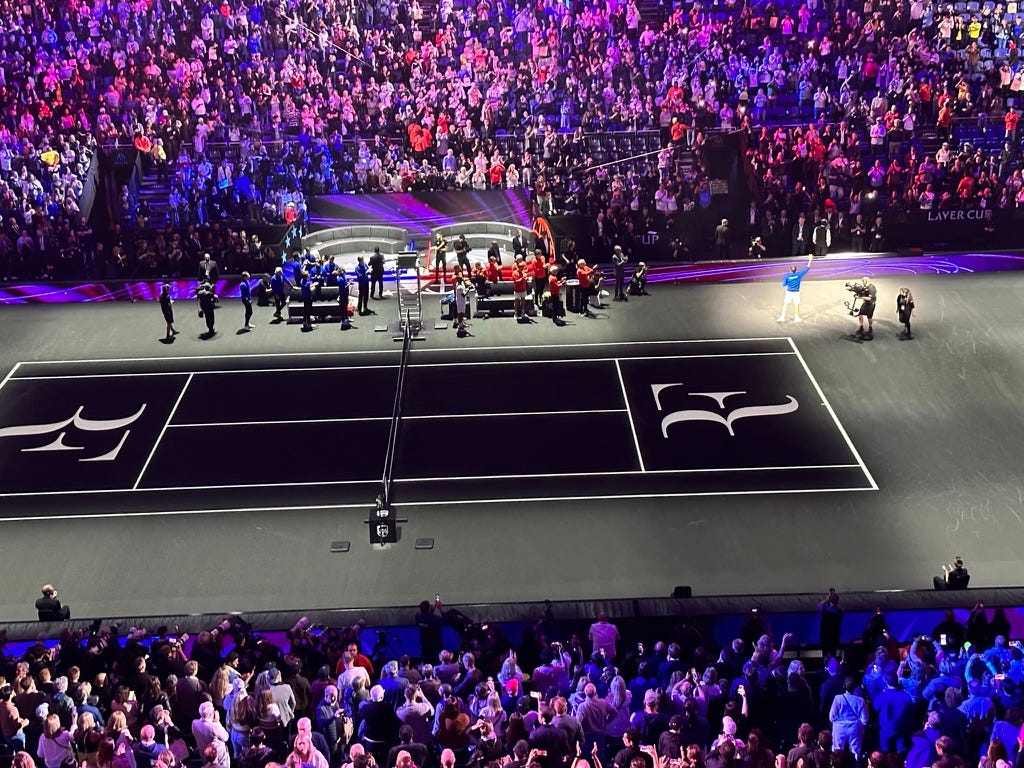
Respect everyone. Fear no one. RF.
Those are the initials on the logo, and they are the frequency worth repeating to yourself. One worth letting hum.

If this moved something in you, share it with someone.
Find me on X: @sunil_hebbar